| Category | Details |
|---|---|
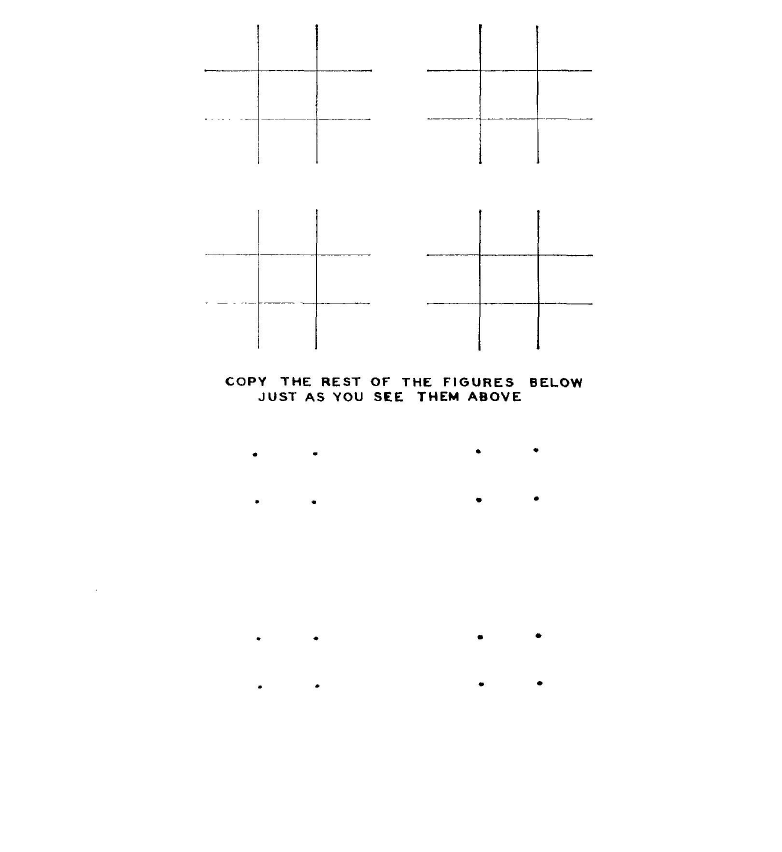
| Description | The Perceptual Closure and Design Scales were developed by Irving A. Taylor (1960) to assess perceptual reactions in individuals with opposing social attitudes, ranging from extreme conservatism to extreme liberalism. The study used incomplete visual representations, such as a house and a boy, composed of lines with small gaps. Participants were instructed to complete the figures by reproducing them as accurately as possible. The study aimed to explore completion tendencies under closure conditions, where an interrupted line is perceived as a single, cohesive shape. Results showed a 17% underestimation of the gap sizes, with the boy scale displaying a greater completion tendency compared to the house scale. The scales demonstrated strong internal consistency with reliability coefficients of .85 for the house scale and .90 for the boy scale, and a correlation of .62 (corrected to .71) between the two scales. The combined scores showed a significant curvilinear relationship for consistent social attitude samples. |
| Author | Taylor, Irving A. |
| Purpose | To measure the tendency to complete incomplete visual stimuli and examine its relationship to extreme social attitudes. |
| Construct | Perceptual Closure; Social Attitudes |
| Instrument Type | Rating Scale |
| Reliability | Internal Consistency: House Scale = .85, Boy Scale = .90 |
| Validity | No validity indicated |
| Factor Analysis | No factor analysis indicated |
| Test Methodology | Test Reliability; Internal Consistency |
| Test Administration | Paper-based |
| Age Group | Adolescence (13-17 years); Adulthood (18 years & older); Young Adulthood (18-29 years); Thirties (30-39 years); Middle Age (40-64 years) |
| Population Group | Human; Male; Female |
| Population Details | University of Houston Students (Ages 17-61); New York City Secondary School Students |
| Sample Size | Not specified |
| Keywords | Extreme Social Attitudes; Perceptual Closure and Design Scales; Test Development; Internal Consistency |
| Index Terms | Internal Consistency; Perceptual Closure; Pictorial Stimuli; Social Perception; Test Construction; Test Reliability |
| DOI | https://doi.org/10.1037/t06927-000 |
| Reference | Taylor, I. A. (1960). Similarities in the structure of extreme social attitudes. Psychological Monographs: General and Applied, 74(2), 1–36. https://doi.org/10.1037/h0093754 |
Table of Contents
Perceptual Closure and Design Scales

Cite this article
Mohammed looti (2025). Perceptual Closure and Design Scales. Psychological Scales & Instruments Database. Retrieved from https://db.arabpsychology.com/scales/perceptual-closure-and-design-scales/
Mohammed looti. "Perceptual Closure and Design Scales." Psychological Scales & Instruments Database, 28 Oct. 2025, https://db.arabpsychology.com/scales/perceptual-closure-and-design-scales/.
Mohammed looti. "Perceptual Closure and Design Scales." Psychological Scales & Instruments Database, 2025. https://db.arabpsychology.com/scales/perceptual-closure-and-design-scales/.
Mohammed looti (2025) 'Perceptual Closure and Design Scales', Psychological Scales & Instruments Database. Available at: https://db.arabpsychology.com/scales/perceptual-closure-and-design-scales/.
[1] Mohammed looti, "Perceptual Closure and Design Scales," Psychological Scales & Instruments Database, vol. X, no. Y, ص Z-Z, October, 2025.
Mohammed looti. Perceptual Closure and Design Scales. Psychological Scales & Instruments Database. 2025;vol(issue):pages.